Do you actually need Shopify? We built a store without it to find out.
If your brand sells year-round at steady volume: yes, pay for Shopify and move on. But if you sell in seasons with a small catalog, the math has flipped. Shopify has no plan that keeps a real website live while costing zero in the months you are closed, and AI coding tools have collapsed the cost of the custom alternative to roughly a domain registration plus Stripe's cut. We know because we built one, and it is live.
A client asked us a question that sounded almost naive: why do we need Shopify at all? Why wouldn't we just build this with Claude Code? We gave the standard operator answer. Then we caught ourselves reciting instead of testing. This is what happened when we tested.
The knee-jerk answer every operator gives
Shopify is worth it. The checkout has been tuned by billions of transactions. There is an app for everything. Fraud screening, hosting, uptime, PCI compliance: someone else owns all of it, and they wake up at 2am so you don't have to. Build costs are lower, maintenance is lower, reliability is higher.
All of that is true. It is also a habit. We have helped consumer brands run on Shopify for years, and we realized we had never once priced the alternative with modern tools in hand. "Trust us, you need it" is not an answer we like giving. So we went looking for a test case.
The test case: a store that sells a few weeks a year
It walked into the kitchen. Our founder's daughter needed a summer job before college. The neighborhood, a beach community on Puget Sound south of Seattle, had more identity than merch. And the selling pattern was the exact shape platform pricing punishes: a summer run, a holiday run, and quiet the rest of the year.
So we built her Seacoma Supply Co.: hoodies, tees, and caps made for the grey-coast life, printed to order in Burien, WA. Yes, because she is the founder's daughter. But just as much because this was a real opportunity to learn and test with our own hands instead of leaning on the reflex that everyone should be on Shopify. The result is not a mockup or a demo. It is a live store with real orders, real shipping labels, and a teenager running fulfillment.
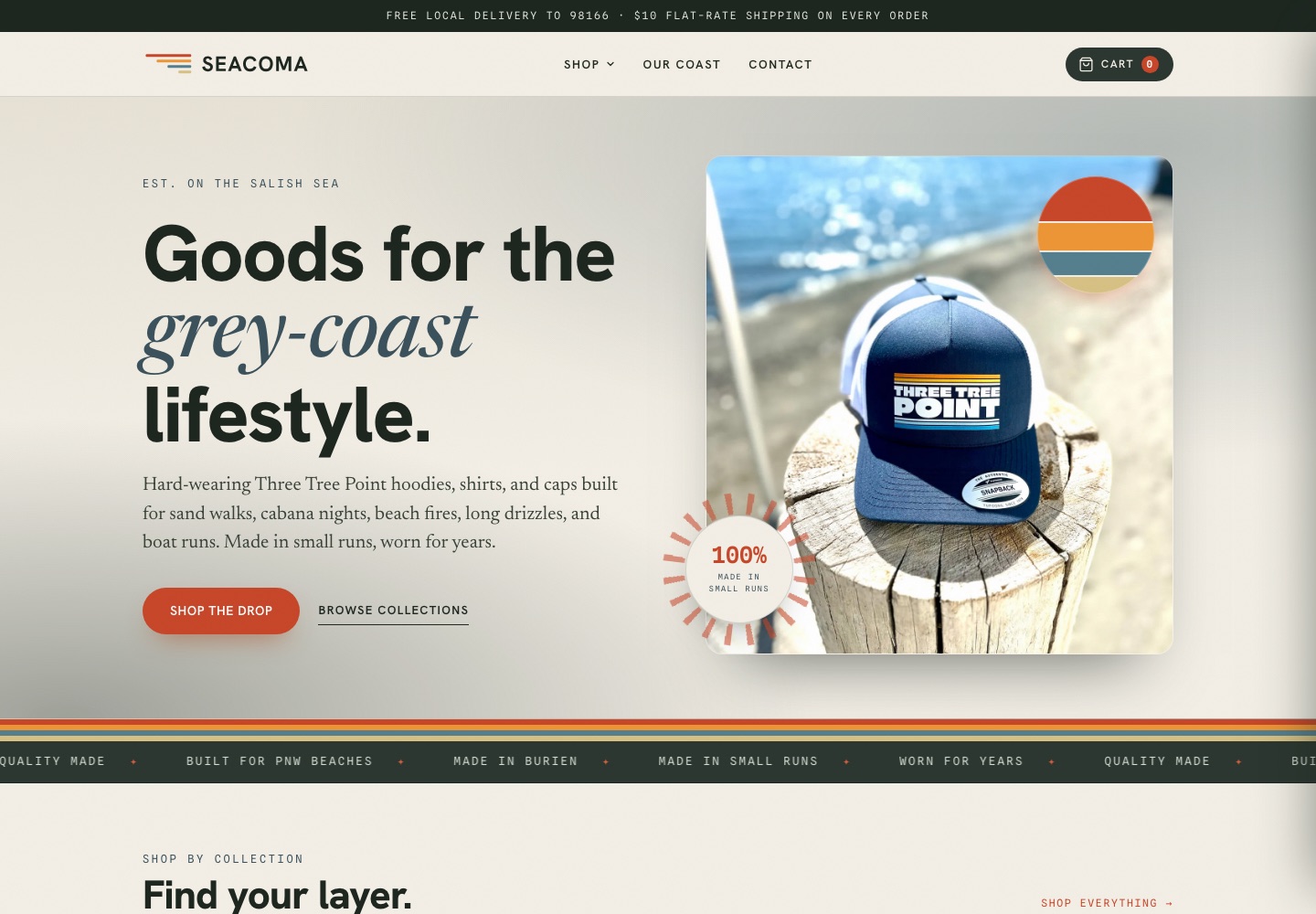
The whole thing is:
- A static site plus one serverless function. No framework, no build step, no monthly platform fee. It runs on Cloudflare, which is effectively free at this scale.
- Stripe Embedded Checkout. Cards, Apple Pay, Google Pay, receipts, and fraud screening, all hosted by Stripe. We never touch a card number.
- A product catalog in one file. It renders the product pages, feeds the checkout price list, and generates the sitemap. Change a price once and everything follows.
- A cart, local delivery rules, and flat-rate shipping. Free delivery in the home ZIP code, one flat rate for everyone else.
- A small orders admin backed by a database, so fulfillment isn't a group chat. (It mirrors to a spreadsheet anyway, because habits.)
- Real analytics and real SEO plumbing. Ecommerce events, product schema, OG cards, a generated sitemap. The neighborhood merch store ships cleaner structured data than most funded brands we meet.
Total build time: evenings across a couple of weeks, with Claude Code doing the heavy lifting and us supplying the judgment. Fixed cost to keep it alive: the domain.
Does the $5 Shopify plan get you a website? No.
This is the rebuttal people reach for first, so let's be precise. Shopify Starter at $5 a month is not a website. It is Shopify's checkout plus a single Shopify-hosted link page: product links, a contact page, and 5% transaction fees. No theme editing, no blog, no custom domain. It is built for selling through DMs and link-in-bio, and it is genuinely good at that. But seacomasupply.com could not exist on Starter, and neither could your brand's site.
Pause and Build, the $9 plan people mention next, is the mirror image: your website stays up and your checkout turns off. You can be seen or you can sell. Not both.
The cheapest Shopify plan with a real website and a working checkout on your own domain is Basic at $39 a month, or $29 on annual billing. As of mid-2026, the low end of Shopify pricing looks like this:
| Option | What it costs | Real site on your domain | Can take an order |
|---|---|---|---|
| Shopify Starter | $5/mo + 5% per sale | No | Yes, via link pages |
| Shopify Pause and Build | $9/mo | Yes | No, checkout is off |
| Shopify Basic | $39/mo ($29 annual) | Yes | Yes |
| Custom site + Stripe | ~$12/yr domain + 2.9% and 30¢ per sale | Yes | Yes |
The math for a seasonal brand
Run the year for a brand that sells in two windows, summer and holidays. On Shopify you would keep Basic live for the five selling months and drop to Pause and Build for the other seven: about $258 in fixed cost for the year before a theme, apps, or email tools, and your checkout is dark for seven of those months anyway. The custom store's fixed cost is the domain, about $12, and card processing is a wash: Shopify Payments on Basic and Stripe both land around 2.9% plus 30 cents for online cards.
Fixed cost by month: a brand that sells summer and holidays
Shopify: Basic at $39/mo while selling, Pause and Build at $9/mo between. Custom store: the domain.
The point is not the couple hundred dollars. The point is the shape. Shopify's pricing assumes continuous commerce: every plan is rent, and rent is due whether the shop is open or not. A seasonal brand pays for twelve months to sell in three. The custom store idles at zero and wakes up the instant someone buys a hoodie.
Shopify vs. a Claude Code build: how they compare
The verdict up front: Shopify wins on operations at volume, and the custom build wins on cost shape and control for a small seasonal catalog. Here is the side-by-side we wish we had when the question first came up.
| What you're weighing | Shopify (Basic) | Custom build (Claude Code + Stripe) |
|---|---|---|
| Fixed cost | $39/mo, $29 on annual billing | About $12/yr for the domain |
| Cost in months with no sales | $39/mo live, or $9/mo paused with checkout off | $0, and the site stays live and able to sell |
| Getting to launch | Theme-based, live in days, no code | AI-assisted build over days to weeks, needs someone technical |
| Checkout | Shopify Checkout with digital wallets | Stripe hosted checkout with digital wallets, PCI carried by Stripe |
| Card processing | About 2.9% + 30¢ online | 2.9% + 30¢ |
| Apps and ecosystem | Thousands of apps, POS, subscriptions, loyalty | You build it, or you do without |
| Maintenance | The platform handles it | You or your builder own it |
| Best for | Steady year-round volume, deep catalogs, non-technical teams | Seasonal windows, small catalogs, brand-first sites |
Neither column is the moral high ground. They are different cost shapes for different selling shapes, and the mistake is defaulting to either one without doing this table for your own brand.
What Shopify gives you that we had to build
Skipping the platform doesn't make the platform's work disappear. It moves it. Here is where it went, honestly.
Stripe absorbed most of what people mean by "checkout"
The payment form, digital wallets, receipts, card storage, fraud screening, PCI compliance: all Stripe, all hosted, all invisible to us. This is the part everyone assumes is the hard part. It wasn't. If you take one technical fact away from this piece, take that one.
AI made the rest of the storefront cheap
Product pages, collections, the cart, order notifications, the admin dashboard, structured data, the sitemap. Each of those was an evening, not a sprint. Five years ago that list was the reason you paid an agency tens of thousands of dollars or paid Shopify forever. That is the part that changed, and it is the reason our client's "naive" question deserved a real answer.
The parts we did not replace
And this is where the honesty matters. Printing to order means the store carries no inventory, so we never had to rebuild inventory sync. Pricing is tax-included, and she remits the sales tax to the state herself, which is fine at neighborhood volume and a real job beyond it. There is no returns portal, no discount engine, no abandoned-cart flow, no POS, no app store, and no support line to call. At our scale, none of that matters. At forty orders a week, all of it does. That list is what $39 a month actually buys, and at real volume it is a bargain.
Who should stay on Shopify
Most brands doing steady volume, honestly. Stay on the platform if:
- Orders arrive every week, year-round. Shopify's value scales with order count and the fee doesn't. The crossover comes fast.
- The catalog is deep or messy. Lots of SKUs, variants, exchanges, and returns are exactly what the platform is for.
- You sell in person or wholesale. POS and B2B are platform territory, full stop.
- Nobody on the team is technical. A custom store is a small system someone has to own. If that someone is a contractor who may not pick up the phone in November, that risk is worth $39 a month.
- Your growth runs on apps. Subscriptions, loyalty, reviews, bundles: renting them beats rebuilding them while you scale.
If orders arrive every day instead of every season, the platform fee is the cheapest operations hire you will ever make.
You're a candidate for the custom route if...
- You sell in windows: drops, seasons, holidays, events, a fundraiser.
- Your catalog is a dozen SKUs or fewer, with simple variants.
- Fulfillment is simple: print on demand, local pickup, or flat-rate shipping.
- The website is the brand. The story matters as much as the cart.
- Someone on the team can drive AI coding tools, or you have a builder on call.
- You want fixed costs at zero during the dark months.
Score yourself honestly on the last two. The build is no longer the hard part. The willingness to own a small system is.
What we tell bigger brands now
The client who started all this got a better answer than the one we almost gave. They should be on Shopify, and now we can say precisely why: continuous volume, a deep catalog, a non-technical team, and unit economics that barely notice the fee. But their question wasn't silly. It was early. The boundary between "you need a platform" and "you need a builder for a week" has moved a long way in two years, and it is still moving. Apps you rent for $200 a month are becoming afternoons of custom code. Microsites, drops, and landing experiences that used to be agency line items are becoming prompts plus judgment.
We don't think you find that boundary by reading about it. You find it by building on both sides of it, with your own hands, on stores you actually care about. That is what Seacoma was for. That, and getting a kid to college.
Questions founders ask about skipping Shopify
Does the $5 Shopify Starter plan include a website?
No. Starter includes Shopify checkout and a single Shopify-hosted page with product links and a contact page. There is no theme editing, no blog, and no custom domain, and transaction fees are 5%. It is designed for selling through social and DM links. The cheapest plan with a full website on your own domain is Basic at $39 a month ($29 on annual billing).
Can I pause my Shopify store during the off-season?
Partially. Pause and Build costs $9 a month and keeps your storefront visible, but checkout is disabled, so you cannot take an order. There is no Shopify plan where a real store idles at zero cost.
How much does it cost to run an online store without Shopify?
For a store like the one we built: about $12 a year for the domain, hosting that is effectively free at small-brand scale, and Stripe's processing fee of 2.9% plus 30 cents when a sale happens. Fixed cost is essentially zero in months with no sales.
Is it safe to sell online without Shopify?
Yes, as long as you never handle card data yourself. A hosted checkout like Stripe's means Stripe runs the payment form, stores the card, screens for fraud, and carries the PCI compliance burden. The store never sees a card number.
Can AI coding tools really build a production store?
Yes, for the right shape of store: small catalog, simple fulfillment, seasonal volume. Our build is a static site plus one serverless function, written with Claude Code over a couple of weeks of evenings, and it takes real orders. What AI does not replace is judgment about taxes, refunds, fulfillment, and when you have outgrown the approach.
When is Shopify clearly the right choice?
Steady year-round orders, a growing catalog with variants and returns, retail or wholesale channels, a non-technical team, or real dependence on the app ecosystem for subscriptions, loyalty, or reviews. Shopify's value scales with order volume, and past a modest weekly order count it beats a custom stack easily.
Is Shopify worth it for a seasonal business?
Usually yes if you also sell in person or keep steady online volume between seasons. But if the store is truly dark most of the year and the catalog is small, the subscription works against you: the cheapest Shopify setup with a real website costs money every month it sits closed. That is the case where a custom store with Stripe is worth pricing out.
What is the cheapest way to sell online a few times a year?
A static website on your own domain with a hosted checkout like Stripe. Fixed cost is about the price of a domain, and you pay processing fees only when a sale happens. Shopify's low-cost plans do not fit this shape: Starter has no real website, and Pause and Build cannot take an order.
Should I use Shopify or build a site with Claude Code?
Pick Shopify if orders arrive year-round, the catalog is deep, or nobody on the team is technical. Pick a custom build with Claude Code and Stripe if you sell in short windows, carry a dozen SKUs or fewer, and want zero fixed cost between seasons. The custom route trades a monthly fee for owning a small system, so make sure someone is willing to own it.
Not sure which side of the line you're on?
Tell us your catalog size, your selling cadence, and where your orders come from. We'll give you an honest read: platform, custom build, or a hybrid. Sometimes the answer is "stay on Shopify," and we'll tell you that too.
Let's Talk →