True margin for Shopify operators.
Most Shopify operators can see revenue before lunch. True margin takes the rest of the week, because free gifts, discounts, unit cost, and ad spend sit in different tools. The plan for this week, when it exists, is a note someone writes after the exports. We built and tested a private Shopify app in Inio's Lab for that gap. It brings the tools a brand already runs into one view, keeps a margin you can trust, and turns both into a plan for this week.
Revenue in one tab, margin in six
Brand A is a stand-in for that week: a Shopify brand in the range we keep seeing, about $1M to $50M a year, where the person who still knows the numbers is the founder or the one operator who opens every tab.
Monday starts in Shopify, because the orders are there. The ad accounts are next, for what the ads cost. The email tool has what went out and who clicked. The subscription tool has the skips. Shipping is an export. Unit cost lives in a sheet someone updates when inventory arrives. The monthly P&L shows up after the books close, in its own file.
None of those screens is wrong. None of them is the order. A free gift shipped with the unit. A discount code took a slice off the price. The ad that brought the visit sits in another account, with its own idea of a new customer. The unit's cost depends on which inventory lot it came from. Add those up by hand and the margin moves. Leave them out and the margin is a story about revenue.
By Thursday the question is no longer what happened. It is what to do before next Monday. The answer is usually a paragraph in a doc, written from memory, with one action for ads and nothing for the gift threshold.
A chart is not a join
Off-the-shelf reporting can chart revenue, sessions, and spend, and Shopify already does a lot of that well. What it does not do on its own is join each order to its real cost, the ad that brought it, its discount, and any free gift. A business intelligence tool can be bent into that join, if someone on the team will own the model, the definitions, and the Monday rebuild.
Brand A did not have that person, and the operator did not want a second job as a data team. Another dashboard would have added a tab without naming what was missing: the gift, the lot, the discount, and the ad, on the same order. A chart also stops short of the decision. Someone still has to notice what changed, pick a next step, and write it down.
What we built in The Lab
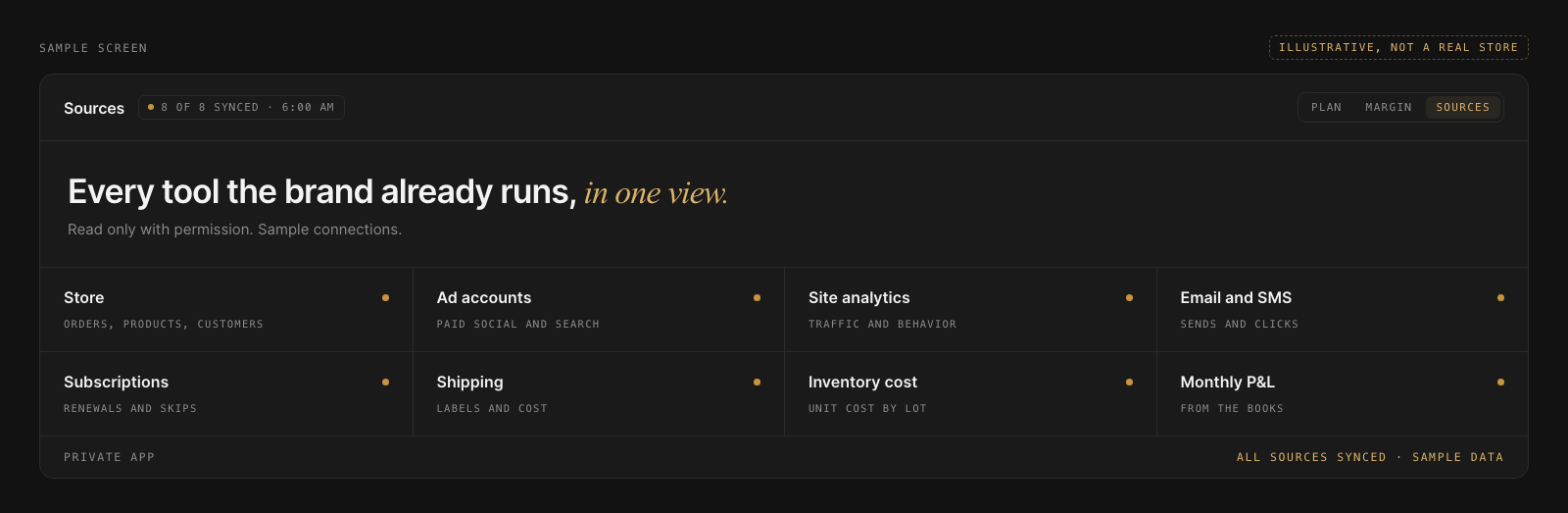
The app installs privately on a Shopify store and reads the tools the brand already runs, only with permission: the store itself, the ad accounts, site analytics, email and SMS, subscriptions, shipping, inventory cost, and the monthly P&L. Each store's data stays in its own private setup, is used only to run the app for that store, and is deleted on request.
Three jobs sit on that join:
- One view. Every source shows up together with a sync status, so you can see whether the picture is complete before you trust a percentage.
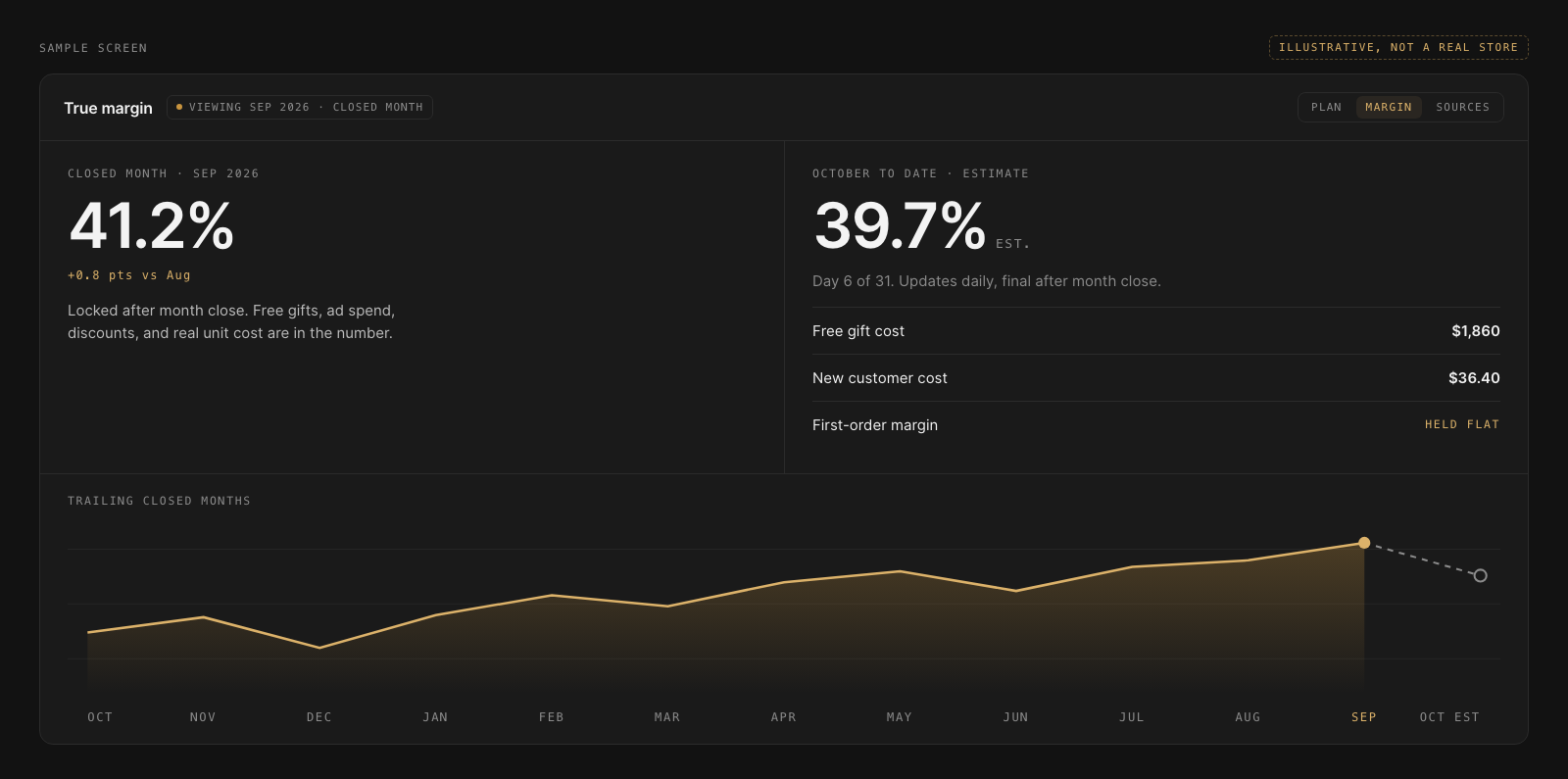
- True margin. A closed month stays labelled, so the number you reported does not move. An open month gets a month-to-date estimate, labelled as an estimate.
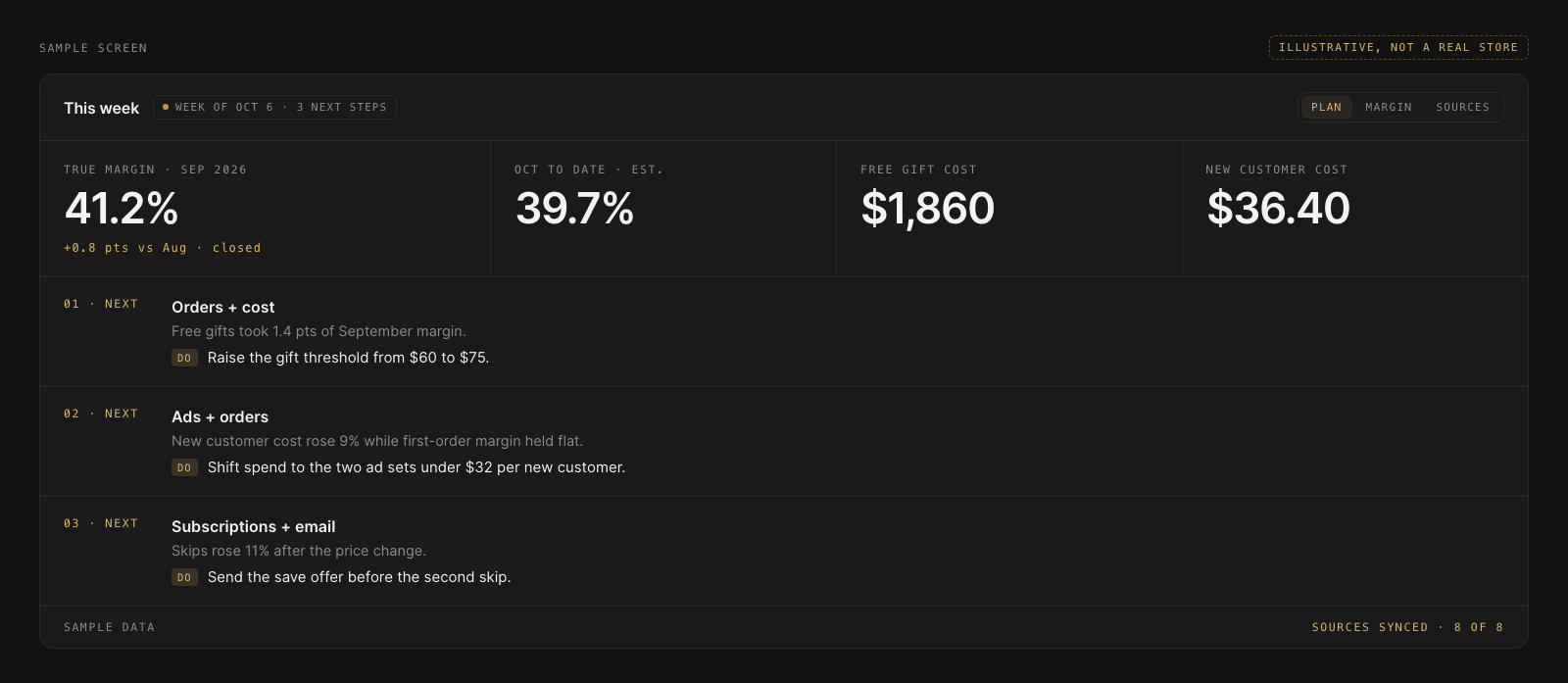
- A plan for this week. What changed across the tools, with a next step for each finding.
The figures below are sample screens. Every percentage, dollar amount, and date on them is illustrative. They are not a customer result and not a real store.
Closed month, then the estimate
Two labels mattered more than any chart style. A closed month should stay the number you reported. An open month should say it is an estimate, and it should be allowed to move until the books close. Mix the two and a reported margin quietly changes weeks later, when someone finally prices the gift.
A margin that gets revised after the meeting is not a margin you can take into the meeting. An open month with no estimate is a blind spot until the P&L arrives. Both numbers can sit on the same screen if each one says what it is.
The cost side follows the same rule. Unit cost comes from the monthly inventory lot, so a lot that lands at a higher cost shows up in the orders that consumed it. Free gifts are carried into those orders instead of living in a merchandising note finance never sees.
The labelA closed month stays.
The brief is a next step, not a longer chart
The weekly plan is a short list. The sample brief has three findings: a gift threshold, where to move ad spend when new-customer cost rises and first-order margin does not, and a save offer before a second subscription skip. The numbers are sample data. The shape is the product: what changed, and a next step for each finding.
The brief can arrive weekly or daily, automatically. Automatic delivery is a copy of the brief, not permission to change a price, shift spend, or send an email. The screen puts the next step beside the finding. A person still decides whether to take it.
Still rough, on purpose
It is a private app, not a public product. There is no signup page and no published price.
The sources are the ones listed above. A brand that runs something else can ask, but the list does not already cover every ERP, subscription tool, or ad account.
The open month is an estimate on purpose. If you need a number that will not move, use the closed month. If you need a read before the books close, use the estimate and keep the label on it.
If you are stitching the week by hand
- Put the closed month and the open month on different labels. A reported margin that still moves is a draft.
- Join the order before you argue about the percentage. Real cost, the ad that brought it, the discount, and any free gift belong on the same order.
- Carry the gift and the inventory lot into the order. A gift that only shows up in a merchandising report is a gift you will underprice.
- Ask for a next step with every finding. A chart without a move becomes another tab.
- Keep the brief a suggestion. Delivery can be automatic. The decision stays with the operator.
Questions operators ask about true margin
What is true margin for a Shopify brand?
True margin is what an order actually earns once its real unit cost, its discount, any free gift, and the ad spend that brought it are counted. Shopify reports revenue well, but those costs live in other tools, so true margin needs each order joined to them.
Why should a closed month's margin stay locked?
Because it is the number you already reported. If a closed month can be revised later, when someone finally prices a free gift, the margin you took into a meeting quietly changes. Keep the closed month labelled and fixed, and show the open month separately as a month-to-date estimate.
How do free gifts and inventory cost change margin?
A free gift is a real cost on the order it ships with, even though it rarely shows up next to that order. Inventory cost changes when a new lot lands at a different unit cost. Carrying both into the orders they belong to is often the difference between a margin that looks healthy and one that is.
Where does the app come from, and can I use it?
We built and tested it in Inio's Lab. It is a private Shopify app, not a public product. If you want to see it on your own store's numbers, contact Inio.
See it on your own numbers.
The app is private and built in Inio's Lab. If you want a margin you can trust and a plan for this week on your own store, or an operator in the seat, start with a conversation.
Let's talk →